
Expert analysis
Middle East: Hope for De-escalation, but Risks Remain Elevated
The potential price decline highlighted in the #WhatToWatch post has now materialized:
- Over the weekend, the United States and Iran suspended their reciprocal military strikes after Donald Trump temporarily paused U.S. airstrikes to allow room for diplomatic negotiations. Iran indicated that if U.S. attacks do not resume, it will also refrain from launching further strikes.
- According to Reuters, the decision was driven in part by military considerations. The U.S. administration believes that most previously designated targets have already been struck, while concerns have grown over the depletion of precision-guided munitions.
- Nevertheless, Washington continues to keep the option of resuming military operations on the table.
The market reaction was immediate: Brent crude prices fell by more than 6% to around USD 90 per barrel, while the Dutch TTF gas benchmark dropped by over 8% to approximately EUR 58/MWh, as investors priced out part of the geopolitical risk premium that had previously been built into energy markets.
Despite this, physical energy flows have not yet returned to normal. Fewer than ten cargo vessels per day transited the Strait of Hormuz over the weekend, indicating that shipping companies remain cautious and that a full recovery in maritime traffic is likely to be gradual.
Conditions in the Red Sea have also shown little improvement. Yemen’s Houthi forces carried out another attack on Saudi oil facilities, further disrupting traffic through the Bab el-Mandeb Strait, although a limited number of tankers have resumed using the route.
Overall, markets have responded positively in the short term to the first signs of diplomatic de-escalation. However, physical supply chains have yet to normalize.
Technical Analysis:
TTF Technical Outlook: The front-month TTF natural gas contract declined by nearly 7.7% on Monday, falling to around EUR 58.17/MWh. While the correction has been significant, prices continue to trade above both the 50-day and 100-day moving averages, suggesting that the medium-term bullish trend remains intact.
The 14-day Relative Strength Index (RSI) retreated from Friday’s near-overbought territory (above 70) to around 63, indicating that market overheating has eased, although momentum remains positive.
The MACD continues to generate a bullish signal, although the declining histogram suggests that upward momentum is beginning to weaken.
Key Levels: First support lies around EUR 54.6/MWh. Resistance continues to be observed in the EUR 62–66/MWh zone.
Over the coming days, price action is likely to be driven less by technical indicators and more by whether de-escalation in the Middle East proves sustainable, as well as by the pace at which shipping through the Strait of Hormuz returns to normal.
If no further geopolitical escalation occurs, the correction could extend toward the EUR 54–55/MWh range. Conversely, any renewed military incident could quickly push prices back above EUR 60/MWh.
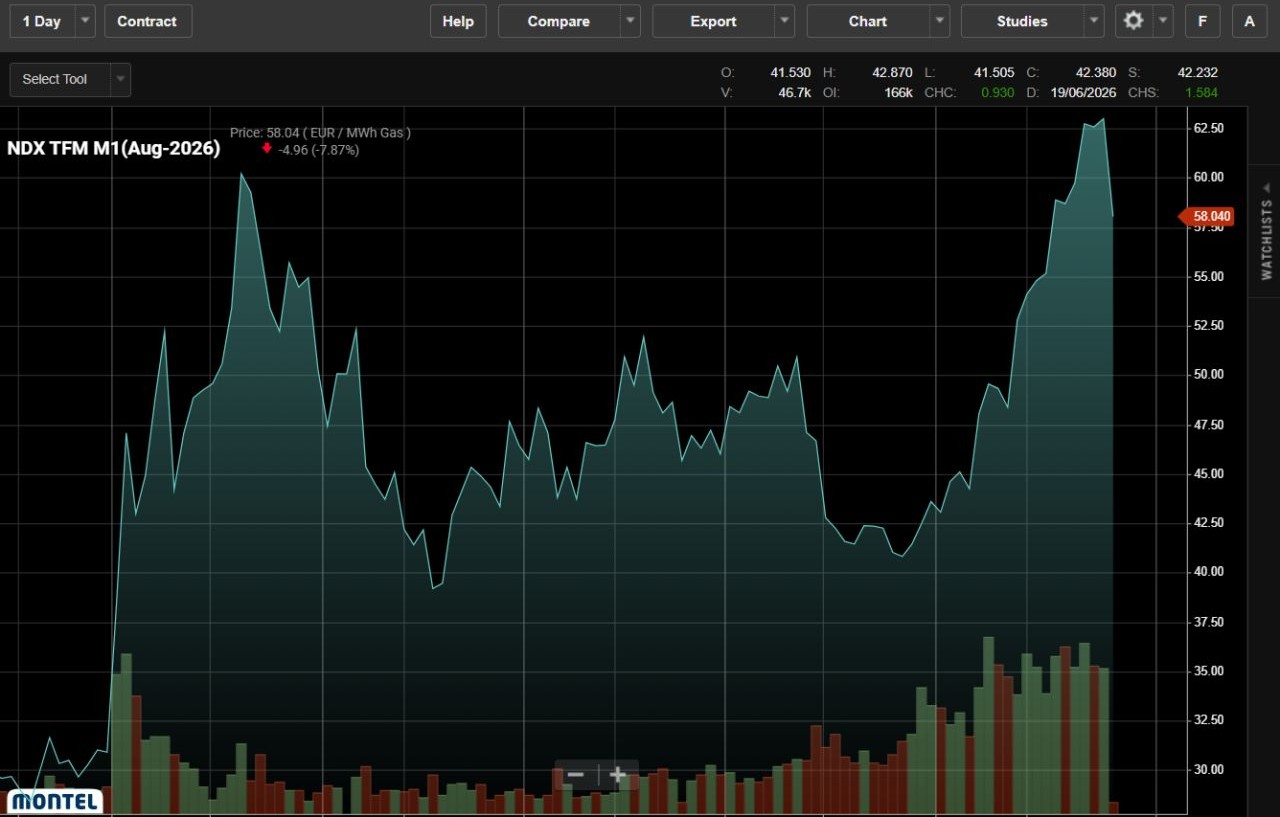
Source of the chart: Montel Analytics
Analysis written on: Tóth Eszter Lilla
27.07.2026.