
Expert analysis
Can the TTF break above €65/MWh and the EUA move through €85/t? Or are we about to see a technical correction and lower prices?
US–Iran
The key question for the market is whether the United States has merely paused its air strikes on Iran or whether this marks the beginning of a genuine diplomatic de-escalation. While the Trump administration has indicated that it currently prefers a diplomatic solution, the naval blockade against Iran remains in place. Any renewed US military action could quickly add another geopolitical risk premium to energy prices. On the other hand, meaningful progress in negotiations could trigger a correction lower.
Geographical expansion of the conflict: This weekend’s developments suggest that the conflict is no longer focused solely on the Strait of Hormuz. Following Houthi attacks on Saudi oil facilities and rising tensions in the Red Sea, markets will closely monitor whether the conflict spreads more permanently to the Bab el-Mandeb Strait, the world’s second most important energy shipping route after Hormuz. This matters because the conflict is no longer limited to a handful of participants (the US, Iran, Israel and Lebanon). A much broader diplomatic effort would now be required to deliver a lasting and meaningful decline in energy prices.
Saudi oil infrastructure: Traders will assess the extent of the damage caused by attacks on Aramco facilities and whether further strikes are likely. The Houthis have already declared that all Saudi oil infrastructure could become legitimate military targets, increasing concerns over global oil supply security.
Strait of Hormuz & LNG exports: The market will continue to focus on shipping through the Strait of Hormuz. According to Kpler, Qatari LNG exports are unlikely to normalize before early 2027, meaning that any news regarding QatarEnergy’s force majeure status or the security of the shipping route could have a significant impact on gas prices.
Weather
European and Asian heatwaves, the US Gulf Coast hurricane season and the development of El Niño remain key drivers of global LNG demand and supply. A prolonged heatwave in Asia could intensify competition between Europe and Asia for LNG cargoes. However, current weather forecasts point to a milder winter, which would be bearish for both European storage requirements and global LNG demand.
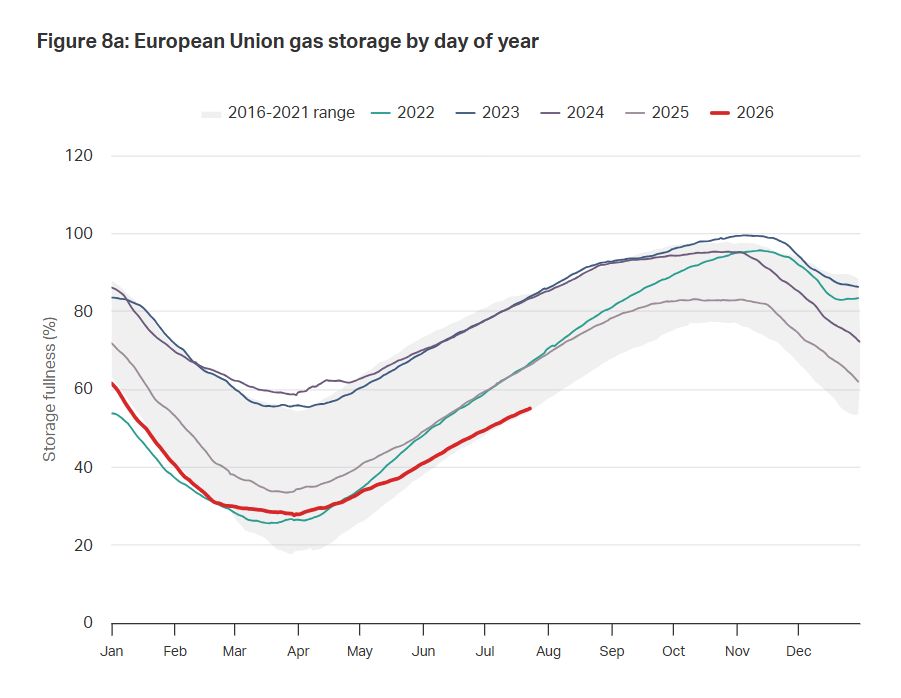
European gas storage
Despite elevated prices, the pace of storage injections remains under close scrutiny. The market will be watching whether Europe can accelerate injections ahead of winter and how LNG imports evolve over the coming weeks.
Carbon market
For EUAs, the key question is whether the market can resume its upward momentum after last week’s profit-taking. Elevated gas and power prices continue to provide fundamental support, although the sharp rally has increased the likelihood of short-term volatility.
Sources: Reuters and Montel News. Chart: Bruegel – Improving Economic Policy.
Analysis written by: Tóth Eszter Lilla
26.07.2026